Worlds & habitats
Proxima b
A life lived in the golden hour.
 THE HUMANALIENS STUDIO
Meet the people. Discover their worlds.
Follow the spacecraft, scenes and ideas that connect them.
A film universe in development. Artwork and short motion studies are not final movie footage.
Explore nine layered compositions and the characters, spacecraft, civilizations and technologies behind them.
VISUAL DEVELOPMENT · NOT A FINAL SHOT ORDER OR FINISHED MOVIE FOOTAGE
Independent world, spacecraft and foreground layers respond at different depths. Pause remains available; reduced motion and data saver are respected.
Nine compositions from three source environments. Layered concept artwork, not completed movie footage. Scene links work without JavaScript.
Explore the Scene Atlas ↗ · Follow the people, ships and worlds behind the layers.
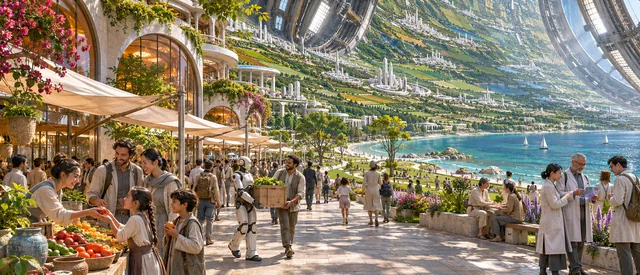
The living-world composition introduces the ordinary lives that make the wider conflict matter. It is an invitation to explore human settlements, not a catalogue of already completed film locations.
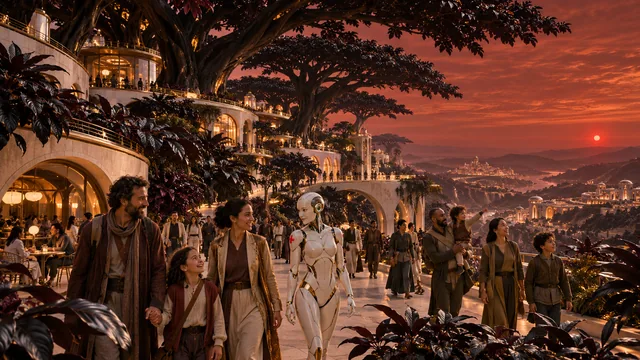
The story begins with a civilization capable of building far beyond its first home, but its emotional scale stays close to people. Streets, classrooms, transport and the way a machine answers someone are as important as the distant skyline. The human-looking Anil Cyborg belongs in this world rather than standing outside it as an unrelated spectacle.
Use the world dossiers to distinguish a planet from an engineered habitat. Haven is a constructed home, while the Proxima b page describes a speculative setting around a real astronomical name. These development images establish atmosphere; they do not certify a physical map, a settled population or a final city design.
Story record: Series Bible sections 3,28.4. Later owner decisions take precedence.
Open the connected dossier ↗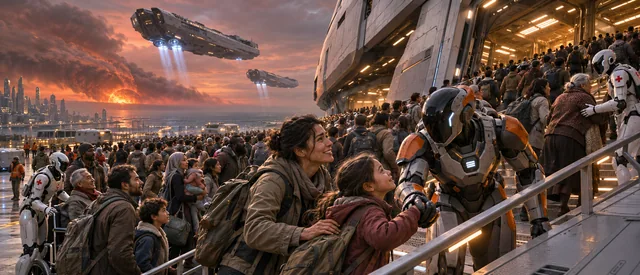
Departure connects Earth, the evacuation fleet and the responsibilities of a machine that can speak. The convoy composition uses human spacecraft layers to explore protection and separation.
A departure is not simply a ship leaving the frame. It connects the people still waiting, the people already aboard and those deciding how long to remain. The owner-approved machine-personality direction gives a vessel a voice and independent operating capability, while its passengers remain people whose safety matters. A suggested line about remaining seats is not a finalized capacity specification.
The last-departure vessel and the human carrier therefore have separate dossiers even when development imagery is shared. One names a particular narrative function; the other describes a fleet role. The transport silhouettes here are contextual, not evidence that every evacuation ship has the same final hull or dimensions.
Story record: Series Bible sections 5,26,28.4. Later owner decisions take precedence.
Open the connected dossier ↗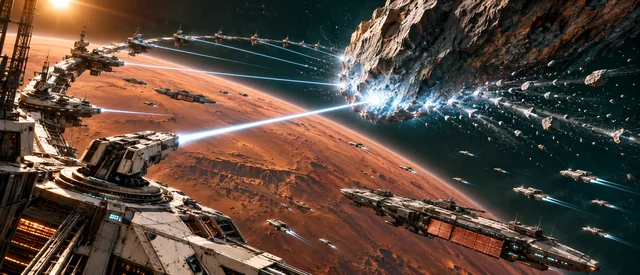
Mars approach places transport and rescue beside the next refuge. Its emphasis is arrival, coordination and care rather than a claim that this is a locked landing sequence.
The rescue-shuttle dossier follows the smaller journeys that connect a large evacuation to an individual life. Docking, access, loading and making room for others can carry the tension of a scene without requiring a new weapon or a new planetary disaster. An orbital dock is infrastructure, not another planet and not interchangeable with the craft using it.
The layered scene places existing spacecraft and Mars-side artwork into a different camera composition. It does not announce an approved flight path, a shuttle passenger count or the final location of an orbital installation. The connected pages separate these roles so that scale studies remain readable without turning temporary design choices into story facts.
Story record: Series Bible sections 5,26,28.4. Later owner decisions take precedence.
Open the connected dossier ↗12-SECOND SILENT ARTWORK MOTION STUDY · NOT FINAL FILM FOOTAGE
Mars defense connects a threatened refuge with the people and systems trying to protect it. The later story decision concerns redirected rocks, not physically moving an entire planet.
Mars is not merely a red backdrop. It is a second home whose danger changes the meaning of the first escape. The defense dossiers explain the roles of the shield concept, the fleet and the characters around the crisis without treating a glowing layer as proof of a working real-world technology.
The current source decision allows an asteroid-scale threat up to the approved story limit, replacing the earlier whole-planet idea. Space battle artwork also remains development work: visible beam streaks and dense debris are graphic references, not a claim of scientifically final effects. The scene page keeps these boundaries next to the spectacle rather than hiding them in a separate production note.
Story record: Series Bible sections 5,18,26. Later owner decisions take precedence.
Open the connected dossier ↗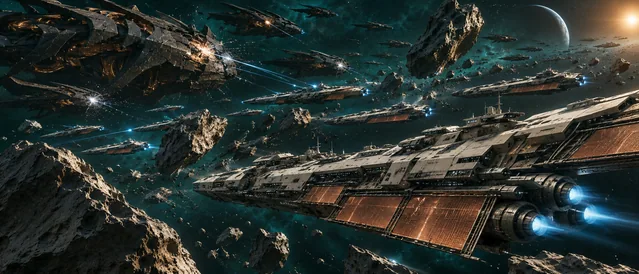
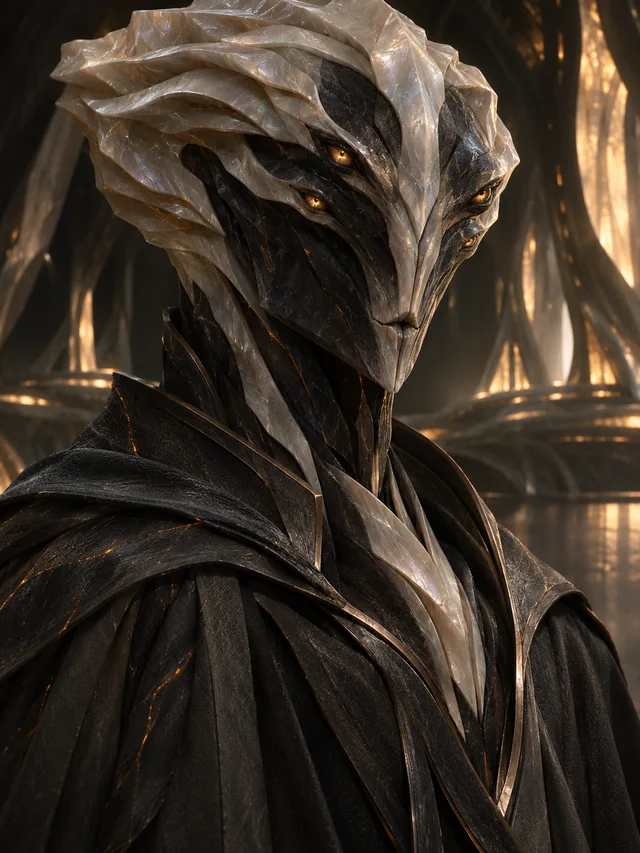
First contact brings human and Orvaan fleet shapes into one visual field. Prime Sereth, the Orvaan civilization and its capital craft are connected subjects, not a single interchangeable enemy.
The Orvaan direction is now named in the owner-approved record, but that does not settle every commander, ship system or political motive. The enemy pages distinguish a named figure, a larger civilization and the machinery it operates. This gives the confrontation a readable structure before any final battle performance is available.
A wide composition can make unequal scale visible without inventing a ship length or fleet strength. Human and Orvaan layers retain their existing visual identities. Follow Prime Sereth for the character direction, the capital-craft dossier for the vessel study and the Concord page for the human-side institutions. A company that makes technology is not automatically the government of those institutions.
Story record: Series Bible sections 4,5,26. Later owner decisions take precedence.
Open the connected dossier ↗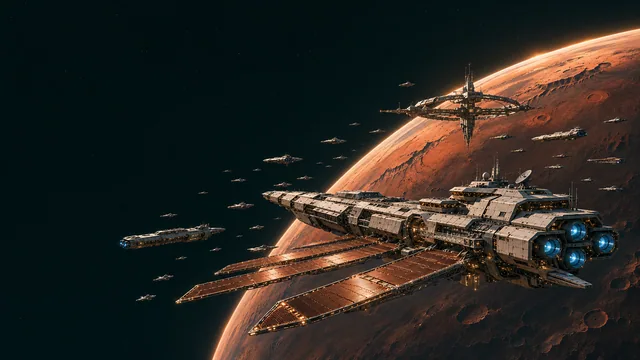
The learning composition treats recovery of understanding as part of the action. Coordination, research and remembered experience connect the fleet to the Persona concept at the heart of the series.
The story gives learning a dramatic role: people and machines must understand what has happened before choosing a response. That is different from making an unexplained upgrade solve every problem. The scene dossier connects the proposed learning interval with the scientists, engineering work and limits already described in the story record.
A Human Persona is learned from a particular person; a default AI Persona is a designed machine identity. The distinction matters when a robot remembers a human life while a spacecraft develops a recognizable way of speaking. A Persona Core is a film-world device, not evidence that biological consciousness has been transferred or that any real individual has been resurrected.
Story record: Series Bible sections 5,16,28. Later owner decisions take precedence.
Open the connected dossier ↗12-SECOND SILENT ARTWORK MOTION STUDY · NOT FINAL FILM FOOTAGE
The countermove is a fleet-scale response built around understanding and protection. Its composition explores opposing spacecraft layers, not an already approved sequence of final shots.
The response should remain larger than a duel between two unusually powerful individuals. Different vessels, crews, institutions and tools have distinct responsibilities. The owner-approved direction places human weaponry in a defensive role, while the current endpoint of the conflict is not presented here as permission to invent a complete final screenplay.
This view uses the human and Orvaan layers already established in the website archive. Relative placement is a visual study, not a navigation solution, a combat simulation or a statement of exact distance. The ship dossiers are the place to inspect those form studies independently; the scene dossier explains why their relationship matters to the story.
Story record: Series Bible sections 5,15,26,28. Later owner decisions take precedence.
Open the connected dossier ↗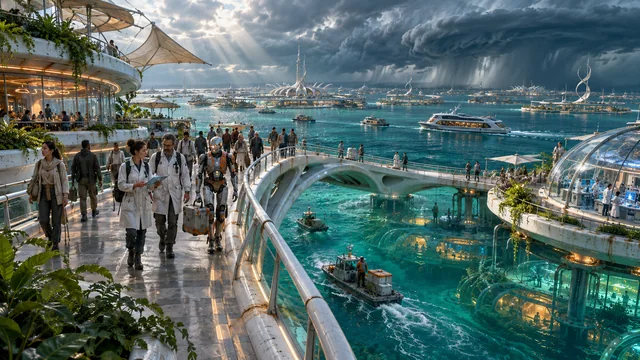
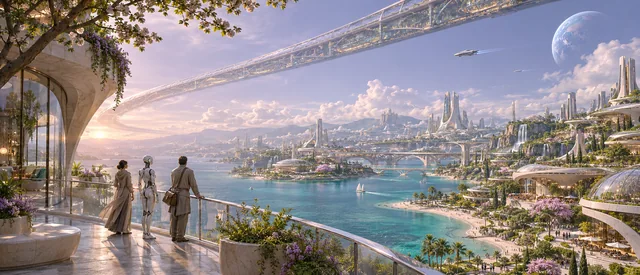
Ordinary lives returns the scale of the universe to a home, a journey and a conversation. The terrace composition illustrates what protection is for rather than adding another battle.
The owner asks for machines that can behave like recognizable members of daily life: a car, a household companion or a helicopter can answer, disagree and help. Their personalities should be expressed through relationships, not only through a glowing interface. These smaller moments give the audience something concrete to care about when the view later expands to a fleet.
The ocean-world dossier develops the idea of floating settlements, while the terrace is contextual artwork reused from the living-world environment. It is not a claim that the illustrated balcony is a finalized Teegarden b location. The vehicle and household pages keep the machine-character concept distinct from the speculative geography.
Story record: Series Bible sections 3,28.4. Later owner decisions take precedence.
Open the connected dossier ↗The recovery composition points toward rebuilding without declaring Earth instantly restored. The current proposed Part II timeline opens in 3026 and reaches a 3038 epilogue.
The delayed-recovery idea gives the ending a cost in time. Rebuilding is not the same event as winning a confrontation, and a hopeful image does not mean that every consequence has disappeared. The timeline page separates the story years from production or release dates; this website does not announce a finished feature or a release calendar.
The Reach dossier explains the proposed infrastructure connection and its fictional limits. The scene uses living-world artwork to evoke possibility, not a certified recovered-Earth map or a final image of the ending. Part II keeps one active Anil Cyborg; the multiple-copy direction belongs to later story development rather than being silently inserted into this chapter.
Story record: Series Bible sections 15,26,28.1. Later owner decisions take precedence.
Open the connected dossier ↗12-SECOND SILENT ARTWORK MOTION STUDY · NOT FINAL FILM FOOTAGE
The Scene Atlas is a visual reading guide connecting nine layered artwork compositions with The Human character, enemy, ship, world and technology dossiers. It is not a finished screenplay or an approved shot order.
No. These are nine camera compositions made from three existing artwork environments. The embedded MP4s are separately labelled silent artwork motion studies, not final film footage or an official trailer.
Use a scene link to open its dossier, or use the live scene controls to inspect its layers. Pointer movement, horizontal touch dragging and arrow keys change perspective. Vertical swipes scroll normally, and motion can be paused.
The atlas follows The Human Series Bible, with later owner decisions in sections 26 and 28 taking precedence. Anil Cyborg is the lead, Part II has one active clone, and earlier whole-planet and Aadi lead proposals are not current canon.
This atlas is a navigation layer over the existing story archive. Its nine compositions reuse three source environments; new framing is not counted as nine new photographs or film shots. Shared artwork retains its contextual label, and existing character portraits retain their actual identities.
The dossiers distinguish owner-approved foundations from working details. The source record does not provide a locked proper name and production-ready visual for every member of every fleet or every proposed world. Those gaps are left visible rather than filled with invented canon. The library remains extensible as the story and art are approved.
Canon and media policy · All entity dossiers · All six motion studies